Travel Blog Template
An Astro 5 travel blog template with React 19 components, interactive maps, fuzzy search, and PWA support.
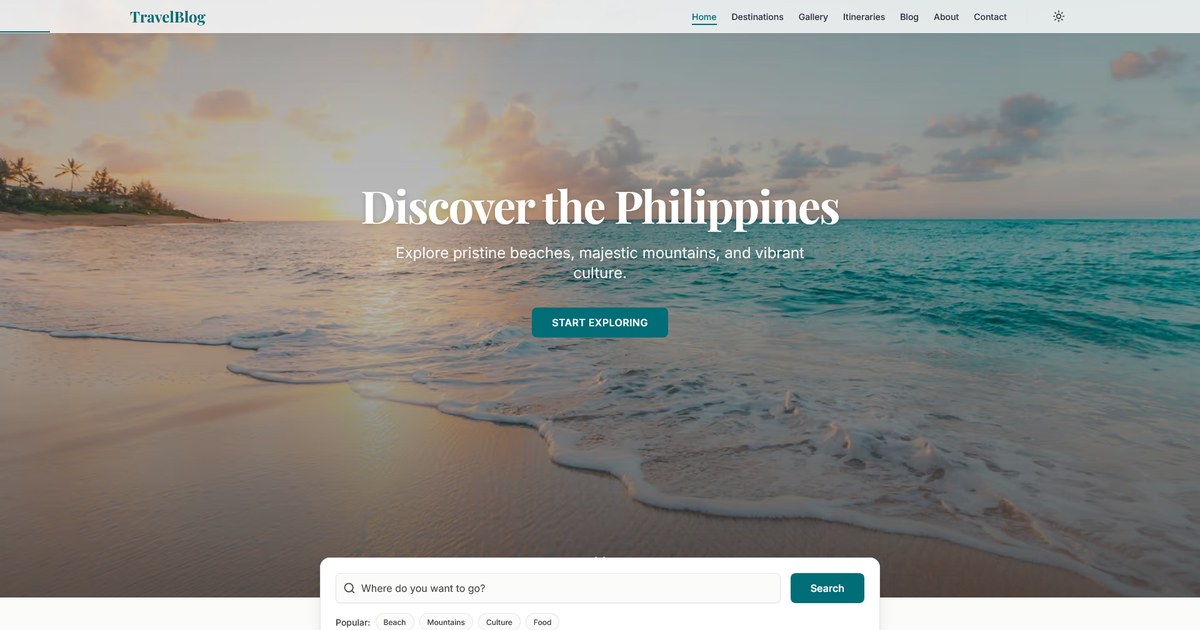
Overview
Travel blogs are content-heavy and trip-focused, which makes them an interesting test case for static-site architecture. The template I built uses Astro 5 and React 19 to combine fast static generation with the interactivity that travel content needs - maps, image galleries, search across years of posts, and offline access for travelers who hit weak connections.
What's included
Per-post layouts, a map view that pins posts to their geography, fuzzy search that handles location names and tags, photo galleries, and PWA scaffolding for offline reading. Tailwind CSS v4 powers the design system. The template assumes the writer is going to keep adding posts indefinitely, so it scales gracefully from ten posts to several hundred.
Why these tech choices
Astro 5 is fast enough that even hundreds of posts compile and serve quickly. React 19 handles the interactive surfaces - the map, the search, the gallery lightbox - while staying out of the way for static content. Tailwind v4 was the right time to adopt because the new theming model fits content-driven sites well.
What I learned
The hardest part of a content-heavy template is that the design has to survive content the original author never imagined. Posts can be long, short, image-heavy, text-only, retroactively edited, or written years apart. The template had to hold all those shapes without breaking visually. That made me much more careful about how I designed the per-post layout - it needed to be tolerant rather than opinionated.